
 Back
Back
September 2, 2026
Most of us don’t think much about GPS until we miss a turn.
We open Google Maps or Apple Maps, check how long it will take to get somewhere and trust that our location will follow along. The same basic technology plays a much bigger role behind the scenes, helping guide packages, vehicles, aircraft and other systems around the world.
But GPS isn’t guaranteed to always be there. That challenge is a big part of what a team right here in Burlington is working to solve.
Skyline Nav AI, founded in 2020, is developing navigation technology designed to work without GPS. While the problem sounds highly technical, CEO and founder, Kanwar Singh, describes the stakes pretty simply.
“The main problem we are trying to solve is, as a country, we are behind on drone and navigation technology,” Singh said. “Our goal is to ensure that we have the capabilities as a country and as a military, that we can operate in any environment with the best drone technology that we need to be successful.”
For Skyline Nav AI, that work is taking shape right here in Burlington at the Northeastern University campus.
When GPS Isn’t an Option
It’s easy to take GPS for granted. It’s there when we need directions, to track a delivery or check how long it will take to get somewhere.
But GPS has a vulnerability: it depends on signals traveling from satellites roughly 12,000 miles above Earth. Those signals can be disrupted, jammed or even “spoofed,” causing a device to believe it is somewhere it isn’t.
It’s a problem that has become increasingly visible in areas experiencing military conflict, including Eastern Europe and the Middle East. But you don’t have to be navigating a battlefield to understand how disruptive losing GPS could be.
“If the blue dot on Google Maps disappeared, that’s going to be quite catastrophic,” Singh explained. “Packages won’t get delivered. We would be late for our commutes. We would get lost easily. That’s how reliant we’ve become on GPS as a society.”
So, Skyline Nav AI is building technology to navigate another way. Its Pathfinder system uses cameras, inertial measurement units and onboard compute to figure out where a vehicle is without depending on GPS satellites. Put simply, it gives a drone, aircraft or other platform another way to know where it is and where it needs to go.
That means the technology has to do more than work on a computer screen. It has to work out in the real world, which brings us to Burlington.
Why Burlington?
When Skyline Nav AI was deciding where to build its team, the company needed more than an office space with good internet connection. It needed engineers and close proximity to fly drones.
Burlington checked both boxes.
“We wanted to ensure that we had access to the rich robotics engineering talent we have here in Massachusetts,” Singh said. “There’s been a long history of robotics companies in the area, so we wanted to tap into the talent pool here.”
That puts Skyline Nav AI in good company. Burlington and the surrounding region are home to businesses working in robotics, aerospace, defense, life sciences, advanced manufacturing and other highly specialized industries.
Access to talent was only half of the equation. If you’re building navigation technology for drones, sooner or later, you have to get a drone off the ground! That can be difficult closer to Boston, where airspace restrictions create additional challenges for testing.
“Because of Burlington and the surrounding communities, we have access to the ability to fly here,” Singh explained. “That makes it easier for us to build a great product that eventually our clients want.”
Built in Burlington, Designed to Go Much Farther
There’s something inspiring about knowing that technology being developed by a company in Burlington could eventually find its way onto a drone, an aircraft, a ship or a ground vehicle somewhere much farther away.
That’s exactly where Singh hopes the company is headed.
“At Skyline Nav AI, we are very excited to build mission-critical technologies that will go on drones, aircraft, maritime and ground platforms,” Singh said. “We’re very excited about doing that right here in Massachusetts, right here in Burlington, for the U.S. and our close allies.”
The “right here in Burlington” part is worth paying attention to.
When we think about Burlington’s business community, it’s easy to picture the places we interact with every day: the restaurant where we grab dinner, the store we stop into or the businesses whose names we see casually driving around town.
But there’s another side to Burlington’s economy that isn’t always as visible. Inside offices, labs and workspaces across town, teams are solving highly technical problems, building new products and developing ideas meant to travel well beyond Burlington.
Skyline Nav AI is one of them. For this team, Burlington provides the talent, location and space to take an ambitious idea out of the lab and see how it performs in the real world.
We’re proud to have Skyline Nav AI building, testing and growing here in Burlington, and we look forward to seeing where they navigate next.
To learn more about our society’s dependence on GPS, Kanwar invites you to get a free copy of his book, Recalculating: Life when GPS goes dark.
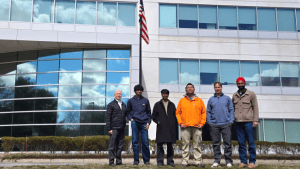
Pictured Above: Skyline Nav AI Crew, Photo by Nick Morodowanec